
Sasha Okun one person exhibition (2010) at Michael Marx, London.
Link to catalogue of images: http://www.sashaokun.com/catalogue/
Sasha Okun:Theatre of the Absurd / Smadar Sheffi
Sasha Okun’s art work does not remain on the gallery walls. It seems to linger in the mind, and stay with the viewer. It seeps into the way we see, slowly revealing what we tend to deny. With manifest virtuosity Okun paints vast scenes of what looks utterly strange and extraordinary, yet resonates as deeply familiar and recognizable. His oeuvre, from the early work of the 1970s, such as Bride, to his Butchers series from 2007 and recent work now in progress in his studio, presents a pitiless, almost raw portrait of “la condition humaine” – the human condition.
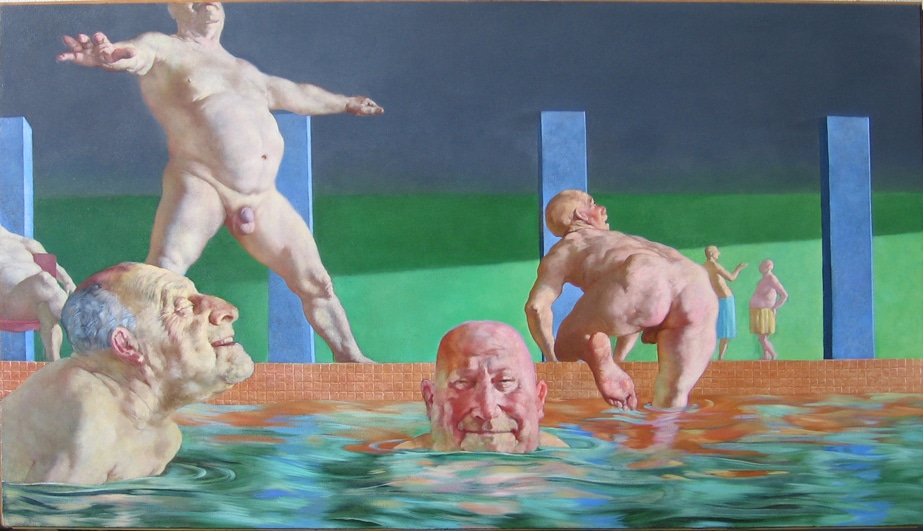
The Human Condition, the name of a 1933 novel by André Malraux, is also the title of two paintings by Magritte from the same year and Hannah Arendt’s famous book of 1958. The distinction Arendt makes between labor, work and action, is one of those colossal ideas that our goal-oriented society and the art world seem to have given up confronting, but Okun does not hesitate to address. The human figure appears in most of Okun’s work, and if we were to place these images in a Last Judgment scene they would surely be on the left, on the side of the damned and doomed. Old and ugly, with bulging flesh and distorted expressions, these figures epitomize the terms 'grotesque,' 'incongruous,' 'unpleasant' and 'disgusting,' but at the same time they are so human and frail that they generate empathy.
Okun (born 1949) grew up in Saint Petersburg, then still Leningrad. He frequented the Hermitage Museum, and in his studio in Jerusalem his eyes sparkle when he mentions its extensive art collection. In 1972 he completed his M.A. studies at the Muchina Academy of Arts and Design in Saint Petersburg and seven years later immigrated to Israel.
In Butchers, a series completed in 2007, Okun creates a fantastic encounter between his memories, the influence of Italian High Renaissance art and Mannerism. In his work we can find affinities mainly to Michelangelo, Titian and Parmagianino (with Piero della Francesco’s near abstraction hovering above) as well as echoes of Francis Bacon and Lucian Freud. Okun's paintings have a distinct fresco quality, with many layers of paint and varnish applied over traditional grisaille. The voluminous, sculptural sensitivity in the paintings reveals a likeness to works of the Old Masters from Giotto and Mantegna to Guido Reni. What may be seen as a deliberate classicizing effect stands in contrast to the protagonists of what seem to be scenes from an unknown play by Beckett, perhaps a Peter Brook production, or a play from Antonin Artaud's “Theatre of Cruelty (Théâtre de la Cruauté). Okun's earlier Butchers (1972) already possessed the fervor of the recent Butchers while bearing resemblance to the work of Neue Sachlichkeit artists such as Otto Dix, George Grosz or Max Beckmann. In his new works, Okun’s signature style is evident and decisive.
Okun’s group of butchers with a lone woman, his Madonna with a rooster, present themselves to the viewer stripped of any finesse. One butcher has a mass of meat before him, dead flesh devoid of any aspirations. The rooster, once held in the arms of this Madonna of death, once lain on a marble slab before three butchers in their bloodstained aprons, symbolizes both the ceremony of kapparot some Jews perform before Yom Kippur (Day of Atonement) and Peter's denials of Christ before his trial. In both instances it is a reminder of human weakness, the inability to face reality, the need to mask our perceptions.
The human quest for distraction as a means of basic spiritual survival, as a substitute for intimacy with one's fellow human beings, is a recurring theme in much of Okun’s work. In Breaking News (2001-2004) he paints a world where there is no I and Thou, as described by Martin Buber in his influential book (1923) but solely “I-It” relationships. Challenging the tyranny of current ideals of beauty, Okun’s images are ageing, deformed, ridiculous characters reclining in what appears to be a godforsaken desert, a void whose borders are the limits of the painting and reality. Clad in their nakedness, nestled together or copulating in a painful, terrifying awareness of their mortality, they form an appalling picture. One wonders if Okun has perhaps gone one step beyond, giving neither his protagonists nor his viewers the grace of “I-It” relationships, but portraying a total emptiness, an “It-It” relationship in which both members are objects.
The bodies are painted as if rising from the barren background in a gruesome embodiment of “Dust thou art, and unto dust thou shalt return” (Genesis 3:19). In this depth of boredom the only thing these cast-off characters hold on to or relate to is a remote control device that can be found in each painting. Like a ritual object, this is a mechanism that promises deliverance, however brief, from meaningless survival. This is the direction of the forward gaze – to a broadcast which is outside the picture.
The title of the series Breaking News, a relatively new broadcasting term that was supposed to convey extremely urgent news, has turned rapidly into a phrase used for any early media coverage of events.
Okun paints these vast deserts of emptiness in near monochromatic colors with the space, the background in which his characters are imprisoned, painted as abstraction in a magnificent contrast to the characters' misery. Layers and layers of paint and fields of color construct a limbo, a doubtful, drifting place.
Two paintings, Bride's Toilette and Groom's Toilette (both 2007) encompass Okun’s extensive dialogue with art history, theatre and his critique of contemporary culture, in particular its commercialization of spiritual values. Okun enters into a dialogue with Renaissance art, such as the famous Piero della Francesca double portrait of Federico da Montefeltro and his wife Battista Sforza (1465-66) but alludes no less to manifestations of the absurd and grotesque in modernism from The Bride Stripped Bare by Her Bachelors, Even (La mariée mise à nu par ses célibataires, même),” Marcel Duchamp’s celebrated artwork (1915-1923), to Alfred Jarry’s play, Ubu Roi (King Ubu), which premiered in 1896.
As in these works, power, the game of domination and submission is the subtext of later versions of Bride's Toilette and Groom's Toilette (Pictures for a Synagogue to be Built, 2009). The enormous, horrendous bride and groom, two figures which epitomize the victory of social conformism are portrayed as monstrous entities towering over the small characters serving them in what looks like an attempt to placate them.
Their nudity is like a knight’s coat of arms, simultaneously protective and aggressive. Portraying a man fitting a white shoe on the bride’s foot, or a woman holding the groom's genitals, Okun depicts the requisites for adhering to social requirements with an ironic smile. It is hard to miss the bride's similarity to the figure of the bride in Pieter Brueghel’s The Peasant Wedding (1568).
Although, strictly speaking, there is no conventional figurative narrative in Okun’s work, with no unity of place and time, he focuses directly on the essential components of the human condition. Okun peels away the subtle layers of denial and detestation, utilizing a rich knowledge of form and color to generate sheer beauty in the background to his figures. This beauty, like a halo, leaves a place for hope, perhaps forgiveness or faith for what is otherwise a godless universe, a theatre of the absurd.

