האיכות של שתי התערוכות המוצגות כעת ב CCA בתל אביב יוצאת דופן וכך גם היחס ביניהן. תערוכתו של אמיר יציב: דין וחשבון בוחנת את השאלה מהו האנושי, ממוסגרת בתווך בין החייתי והבינה המלאכותית כשהוא יוצא מהסיפור של קפקא “דין-וחשבון לאקדמיה” שראה אור ב 1917, בעיצומה של מלחמת העולם הראשונה ; אבשלום: פתרונות ובעיות נוגעת באופן חשוף וישיר בבדידות בחרדה (angst). יחד הן יוצרות הרהור באֶקְזִיסְטֶנְצִיָּאלִיזְם שהצפייה בהן בעת המלחמה מחדדת.
בקומת הכניסה הופך חלל התצוגה למעין אודיטוריום, חלל הרצאות בו מוזמנ/ת הצופה לצפות ולתקשר עם פיטר דמות וירטואלית המופעלת באמצעות בינה מלאכותית. העבודה היא ממעט העבודות בהן השימוש בבינה המלאכותית מאפשרת אפיק יצירה שאינו ספקטקולרי או משחקי אלא מעניק אופציות חדשות.

פיטר של קפקא הוא קוף־אדם שניצוד באפריקה ובמסע המחריד לאירופה למד שחיקוי התנהגות אנושית, בעיקר נפסדת כמו יריקות שיכרות תעניק לו חופש תנועה (חופש במובן הרחב וודאי שאינו בא בחשבון עבורו). באירופה הוא הופך, כך בסיפורו של קפקא למופיע מבוקש במיוחד, אמרגנו מאפשר לו חיים נוחים והוא מדחיק ככל הניתן את מודעותו המלאה למצבו העגום. הסיפור המבריק התייחס לא רק לבעייתיות האינהרנטית בתורת האבולוציה של דרווין, על התפיסה הרואה באדם את נזר הבריאה, אלא גם לתפיסות גזעניות שהשוו יהודים לקופים בקריקטורות, בפרסומים פסוידו-מדעים גזענים, בתעמולה פוליטית ובאמנות תעמולה נאצית. הסיפור פורסם לראשונה ב Der Jude, כתב העת שיסד בובר בזמן מלחמת העולם הראשונה.
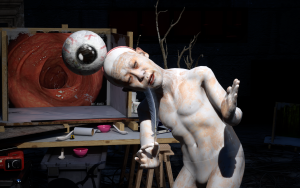
דימוי של העמוד מכתב העת בו הסיפור של קפקא מופיע במיצב הווידאו על הפסנתר עליו מנגן פיטר. מעל הפסנתר דיוקן אישה- קופה, אזכור לדמות הקופה המוזכרת בסוף הסיפור של קפקא, המתוארת כ”שימפנזית קטנה” איתה פיטר “נהנה כדרך הקופים” אך אינו יכול לשאת את לראות “כי מעיניה נשקף הטירוף של חיה מאולפת שנשתבשה דעתה” – כלומר היא משקפת לו את מצבו. בווידאו פיטר מדבר ישירות לצופה, מזכיר את היוצר אמיר יציב וההוראות שניתנו לו, משוחח עם בובות ראש, האחת של גבר והשנייה של קוף, ישן או צופה בטלוויזיה. ההתרחשות היא בחלל קטן, כהה, מרוהט היטב אך סגור כתא כלא. כמעט בכל צילום נראה השעון עם ספרות רומיות גדולות – הזמן הנוקף. פיטר הוא אפוא אמן מסוגר והמבט שלנו הופך אותו לבעל כורחו למבצע מיצג. פיטר, האווטאר אינו חופשי לצאת מהחלל, לחמוק ממבטנו ועובדה זו מפרידה את המיצג ממסורת ארוכה למדי של מיצגי אמנים סגורים בחללים – החל מכריס ברדן שב 1971 נעל את עצמו בלוקר בית ספר לחמישה ימים, דרך I Like America and America Likes Me של יוזף בויס 1974 ועד מרינה אברמוביץ ב The House with the Ocean View מ 2002.

התערוכה היא המשך למופע Peter is Back, מפגש חי בין יציב לבין דמות ה AI שיצר, שכבר עלה מספר רב של פעמים (ואמור לעלות שוב ב CCA). החלקים המעניינים ביותר בתערוכה הם אלו בהשתתפות קהל: על קיר החלל מוצמד מספר טלפון (המופיע מספר פעמים גם בעבודת הווידאו) וחיוג למספר (מהסלולרי של הצופה) מביא למענה של פיטר ולשיחות, בדרך כלל מרתקות. השיח נע בין מה שמזכיר שיחות עם מרכזי שירות מופעלים בבינה מלאכותית – על הנימוס המופלג והניסיון לרצות – למה שנדמה ככנות, תמימות ופגיעות עצומה.

בקומה העליונה, כמו עוד שכבה בתודעה הקהל, מוצגת התערוכה אבשלום: פתרונות ובעיות. לובן החלל מסמא, מכה בצופה אחרי המיצב הכהה שבקומה הראשונה ויוצר מודעות מתוחה של הצופה לנוכחות שלה/ו. אבשלום (מאיר אשל) נפטר ב-1993, בן 29, אחרי קרירה קצרה אך מזהירה. הוא מזוהה במיוחד עם שישה פרוטוטיפים שיצר לתאי מגורים שתכנן להציב בפריז, ציריך, ניו-יורק, תל-אביב, פרנקפורט, וכנראה גם טוקיו. התאים, לבנים לגמרי נועדו לאדם אחד והתאמו למידות גופו. החלל שלהן מכיר תא נזירים אך גם מבנה קבורה, כלומר אדריכלות שמסתכלת לעבר (קטקומבות, חללי הקבורה בתוך פירמידות) מעלה על הדעת גם תופעות כמו מלונות קפסולה ובכל זאת גם בעלת איכות עתידנית כמו זו שאפיינה את האדריכלות הסופרמטיסטית של מלביץ משנות ה 20 של המאה הקודמת.

את התאים תכנן להציב בכמה ערים מרכזיות ברחבי העולם ולגור בהם. העבודה פתרונות (7:34 דקות), היא עבודה בה הדגים, בסרט שמאפשר חקרנות-מציצנות כמעט אנתרופולוגית על חיים בתא מגורים: שינה רחצה ואכילה, אוננות מה שיכול להיקרא כזמן רפלקציה או תפילה. אבשלום שמבצע את כל הפעולות לבוש חולצה לבנה ומכנסיים שחורים, לבוש גנרי של אנשים מקהילות דתיות שונות. שורת הפעולות שיצרו רצף, סדר יום, פורקו ב פתרונות ובעיות בהחלטת האוצרת – הילה כהן-שניידרמן, כך שכל פעולה מוצגת במסך נפרד וחוזרת שוב ושוב. דמותו של אבשלום אינה בגודל טבעי אך היא גדולה למדי. איכות צילום הווידיאו מ 1993 מטשטשת בשל ההגדלה של הפרטים. הטשטוש והחזרות יוצרים תחושה של חלום סיוט, מעשה מכני או טקס שהשתבש, כשהעמיד את המפגש לאינטימי. אבשלום כך נדמה מדגים מערך חוקים, עבודה כמעט דתית – סגפנית, בודדה, מכוונת לנשגב עלום, שממסגר את העבודה בסוג של רומנטיקה.
לצד החלל המרכזי ובו פעולות בחלל התא, מוקרנות שתי עבודות נוספות. ב רעשים (2:30 דקות) אבשלום צורח עד שכוחו תש, כלומר העבודה שייכת למסורת של עבודות מיצג שסיבולת מגדירה את אורכן, מסורת שמרינה אברמוביץ מזוהה איתה עם עבודות כמו Rhythm 4 (1974) בו יצרה היפר ונטילציה, או אמן Bas Jan Ader שביקש לחצות את האוקיאנוס בסירה קטנטנה במסגרת העבודהIn Search of the Miraculous (1975) – היעלמותו הביאה את העבודה לכדי סיום. הצעקה מתייחסת ישירות לציור הצעקה של מונק מ 1893 אך בהקשר ההווה, צפייה בזמן המלחמה, היא מזכירה גם את הצעקה האינדיבידואלית- קולקטיבית בסרט רשת שידור של סידני לומט כשהמונים יוצאים לחלונות לצעוק את תסכולם. מאבק (0:45 דקות) נקראת כמין סיכום לתערוכה כולה – מהצעקה, דרך הפעולות בחלל ועד למיפוי – גילוי גופני של החלל, בתנועות נרחבות וקצובות כריקוד טקסי שנקטע.
התערוכות נוגעות בתחושה של אבסורד – הניסיון להעניק משמעות להתרחשויות הכאוטיות שסביבנו. שתיהן יוצרות אפשרות להתבונן באבסורד, וברצון שלנו להבין, בריחוק הנדרש לראות אותו בבהירות.
אבשלום: פתרונות ובעיות אוצרת הילה כהן-שניידרמן.
CCA תל אביב-יפו צדוק הכהן 2א’, תל אביב-יפו
The quality of the two exhibitions currently on view at the CCA Tel Aviv–Yafo is exceptional—and so, too, is the dialogue between them. Amir Yatziv’s exhibition “Report” examines the question of what constitutes the human, situating it within a conceptual field stretched between the animalistic and artificial intelligence. Its point of departure is Franz Kafka’s short story ”A Report to an Academy,”, published in 1917 at the height of the First World War. ”Absalon: Solutions and Problems” by contrast, addresses loneliness and existential anxiety (angst) with striking directness and exposure. Viewed together, the two exhibitions form a meditation on existentialism whose resonance is sharpened by the experience of viewing them during wartime.
On the ground floor, the exhibition space is transformed into a kind of auditorium or lecture hall, where the visitor is invited to observe and interact with Peter, a virtual character animated by AI. The work belongs to the relatively small group of contemporary artworks in which AI does not serve as spectacle or playful gimmickry but rather opens a genuinely new artistic trajectory.

Kafka’s Peter is an ape captured in Africa who, during the harrowing journey to Europe, discovers that mimicking human behaviour—especially its more debased forms, such as spitting or drinking alcohol—grants him a measure of mobility (freedom in the broader sense remains entirely beyond reach). In Europe he becomes, in Kafka’s narrative, a highly sought-after performer. His impresario secures him a comfortable existence, and Peter suppresses as much as possible any full awareness of the bleakness of his situation. Kafka’s brilliant story addresses not only the inherent tensions within Charles Darwin’s evolutionary theory and the notion of humanity as the “crown of creation,” but also racist discourses that compared Jews to apes in caricatures, pseudo-scientific publications, political propaganda, and later in Nazi visual culture. The story was first published in the journal Der Jude, founded by Martin Buber during the First World War.
An image of the page from the journal in which Kafka’s story appears embedded in the video installation, placed upon the piano played by Peter. Above the instrument hangs a portrait of a an ape-woman, alluding to the female ape mentioned at the end of Kafka’s story, described as a “small chimpanzee” with whom Peter “enjoys himself in the manner of apes,” yet whose gaze he cannot bear, for in her eyes he perceives “the madness of a trained animal gone astray.” She thus reflects his own condition back to him. In the video, Peter addresses the viewer directly, referring to his creator, Amir Yatziv, and the instructions he has been given. He converses with two mannequin heads—one human, one ape—sleeps, or watches television. All this unfolds within a small, dark, carefully furnished interior that nevertheless resembles a prison cell. In almost every shot a large Roman-numeral clock is visible: time inexorably passing. Peter thus becomes a confined artist whose existence is converted—by our gaze—into an involuntary performance. The avatar cannot leave the room or evade our gaze, a fact that separates the work from the fairly long tradition of performances in which artists voluntarily confined themselves in restricted spaces—from Chris Burden’s ”Five Day Locker Piece“ (1971), through Joseph Beuys’s *I Like America and America Likes Me* (1974), to Marina Abramović’s *The House with the Ocean View* (2002).

The exhibition continues the live performance ”Peter Is Back.” a staged encounter between Yatziv and the AI character he created, which has already been presented numerous times and is scheduled to appear again at the CCA. The most compelling moments in the exhibition involve audience participation: a telephone number affixed to the gallery wall (and appearing repeatedly within the video) invites viewers to call from their own mobile phones. Dialling it connects them directly with Peter. These conversations are often unexpectedly captivating. The dialogue oscillates between what resembles interactions with AI-operated service centres—characterized by excessive politeness and a persistent desire to please—and moments that appear disarmingly sincere, naïve, and profoundly vulnerable.

On the upper floor, functioning almost like another layer of consciousness for the visitor, is the exhibition ”Absalon: Solutions and Problems.”. The blinding whiteness of the space strikes the viewer immediately after the dark installation below, producing an acute awareness of one’s own bodily presence. Absalon (born Meir Eshel) died in 1993 at the age of 29 after a short yet dazzling career. He is best known for the six prototypes of living cells he designed to install in Paris, Zurich, New York, Tel Aviv, Frankfurt, and possibly also Tokyo. These entirely white units were conceived for a single inhabitant and calibrated precisely to the dimensions of the body. Their architecture evokes monastic cells but also funerary structures—architectures that look simultaneously backward (to catacombs or burial chambers within pyramids) and forward, bringing to mind phenomena such as capsule hotels, while retaining a distinctly futuristic quality reminiscent of the Suprematist architectural vision of Kazimir Malevich in the 1920s.
Absalon intended to install these cells in several major cities around the world and to inhabit them himself. The video ”Solutions“ (7:34 minutes) demonstrates life within such a cell, offering an almost anthropological voyeurism into its routines: sleeping, washing, eating, masturbation, and what might be described as moments of reflection or prayer. Absalon performs these actions dressed in a white shirt and black trousers—a generic attire associated with various religious communities. The sequence of activities originally formed a daily routine; in ”Solutions and Problems.” however, curator Hila Cohen-Schneiderman has dismantled this continuity so that each action appears on a separate screen, repeating endlessly. Absalon’s figure is not life-size but remains fairly large; the enlargement of the 1993 video footage blurs its details. This blur, together with the repetitions, produces a sensation akin to a nightmarish dream, an errant ritual or disrupted ritual that unexpectedly becomes intimate. Absalon appears to demonstrate a system of rules, a practice almost religious in its austerity: solitary, ascetic, directed toward an unknown sublime, and framed within a distinctly romantic register.
Two additional works are projected adjacent to the central gallery, where the actions within the cell are shown In ”Noises“ (2:30 minutes), Absalon screams until he is exhausted, placing the work in the tradition of endurance-based performance in which physical stamina determines duration—a tradition closely associated with Marina Abramović in works such as ”Rhythm 4“ (1974), as well as with artists like Bas Jan Ader, whose attempt to cross the Atlantic in a tiny boat in ”In Search of the Miraculous“ (1975) ended with his disappearance, bringing the work itself to its conclusion. The scream directly references The Scream (1893) by Edvard Munch, yet in the present context—viewed during wartime—it also recalls the individual and collective outcry depicted in Sidney Lumet’s film Network (1976) where masses lean from their windows to shout their frustration. The short video *Combat* (0:45 minutes) reads almost as a summation of the exhibition as a whole: from the scream, through the actions within the cell, to the bodily mapping of space through expansive, rhythmic movements resembling a ritual dance abruptly interrupted.
Both exhibitions touch upon a sense of absurdity—the attempt to imbue meaning to the chaotic events unfolding around us. Together they offer a space in which to observe that absurdity, and our persistent desire to understand it, from the distance required to perceive it with clarity.
Absalon: Solutions and Problems. Curator: Hila Cohen-Schneiderman
CCA Tel Aviv-Yafo, Tzadok Hacohen 2A, Tel Aviv-Yafo